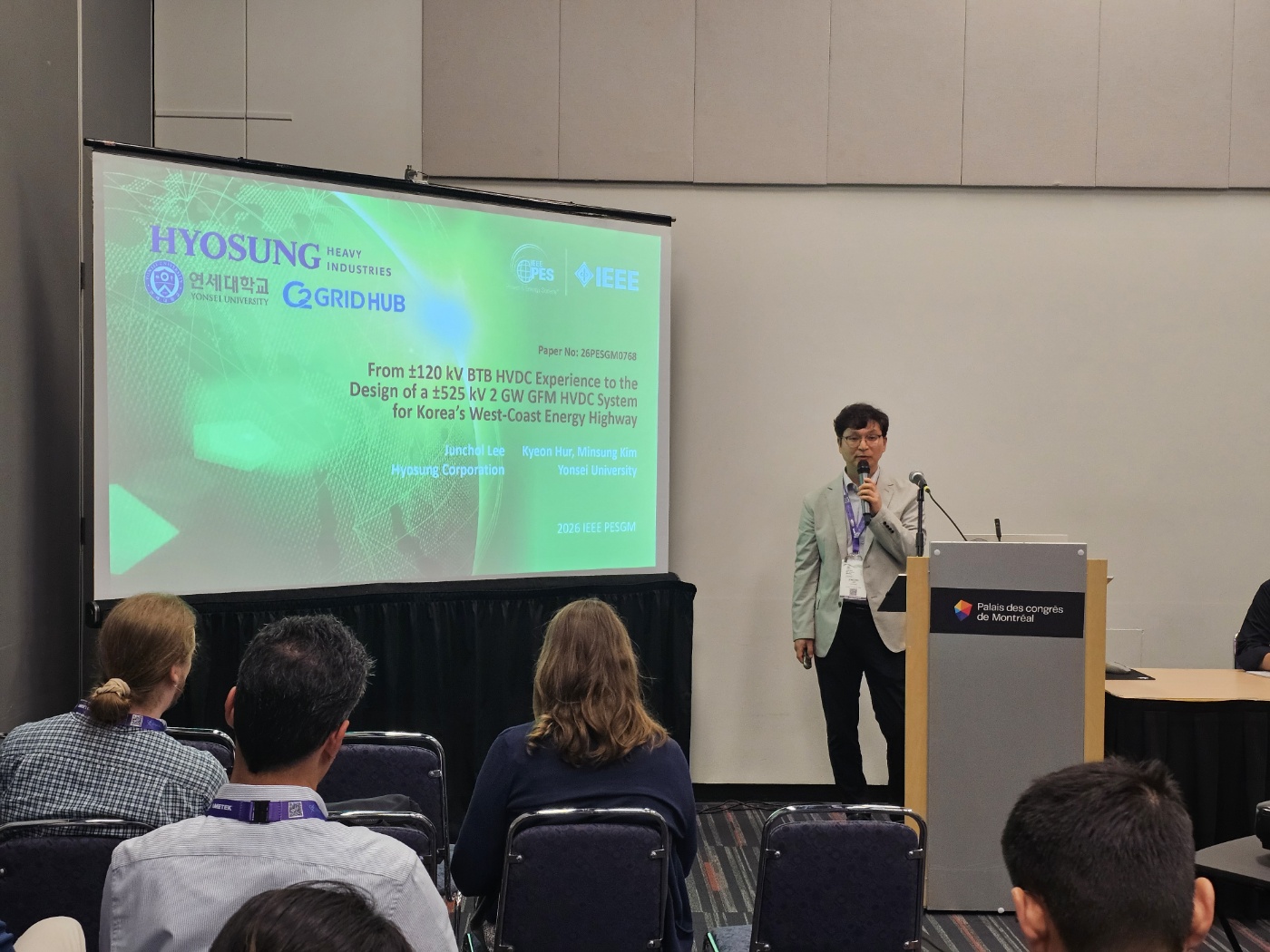
PESGM 2026 Oral Presentations
Junchul Lee participated in PESGM 2026 in Montreal, Canada, where he shared research achievements related to the operating experience of Korea’s commercial BTB MMC-HVDC system and the design, control, and grid-support technologies of a large-scale GFM-HVDC system for the West Coast Energy Highway.

Junchul Lee participated in PESGM 2026 in Montreal, Canada, where he shared research achievements related to the operating experience of Korea’s commercial BTB MMC-HVDC system and the design, control, and grid-support technologies of a large-scale GFM-HVDC system for the West Coast Energy Highway.
What happened
Junchul Lee delivered an oral presentation titled “From ±120 kV BTB HVDC Experience to the Design of a ±525 kV 2 GW GFM HVDC System for Korea’s West-Coast Energy Highway.” The presentation highlighted the design and commissioning experience gained from Korea’s first ±120 kV, 200 MW Yangju BTB MMC-HVDC system, which has been in commercial operation since 2025. The Yangju BTB HVDC system was designed to reduce fault-current levels in the northern Seoul metropolitan grid to below 50 kA while providing flexible power-flow control and dynamic reactive-power support. Building on this experience, the study proposed a design for a ±525 kV, 2 GW bipolar GFM-HVDC system intended to transmit large-scale offshore wind and solar power to the Seoul metropolitan area through the West Coast Energy Highway. To support stable operation in the weak-grid conditions expected in the Saemangeum area, the proposed system incorporates VSM and droop controls. An EMT simulation model was developed based on the 12 GFM interoperability functions defined by InterOPERA. The study also evaluated the inertial response and damping characteristics of the GFM-HVDC system under sudden grid phase-angle changes, verifying its key grid-support capabilities. The system is scheduled for development by 2027, followed by commissioning of the first project by 2030, with real-controller HIL validation planned as the next step.
Photo record
More from the activity