PESGM 2026 Poster Presentations
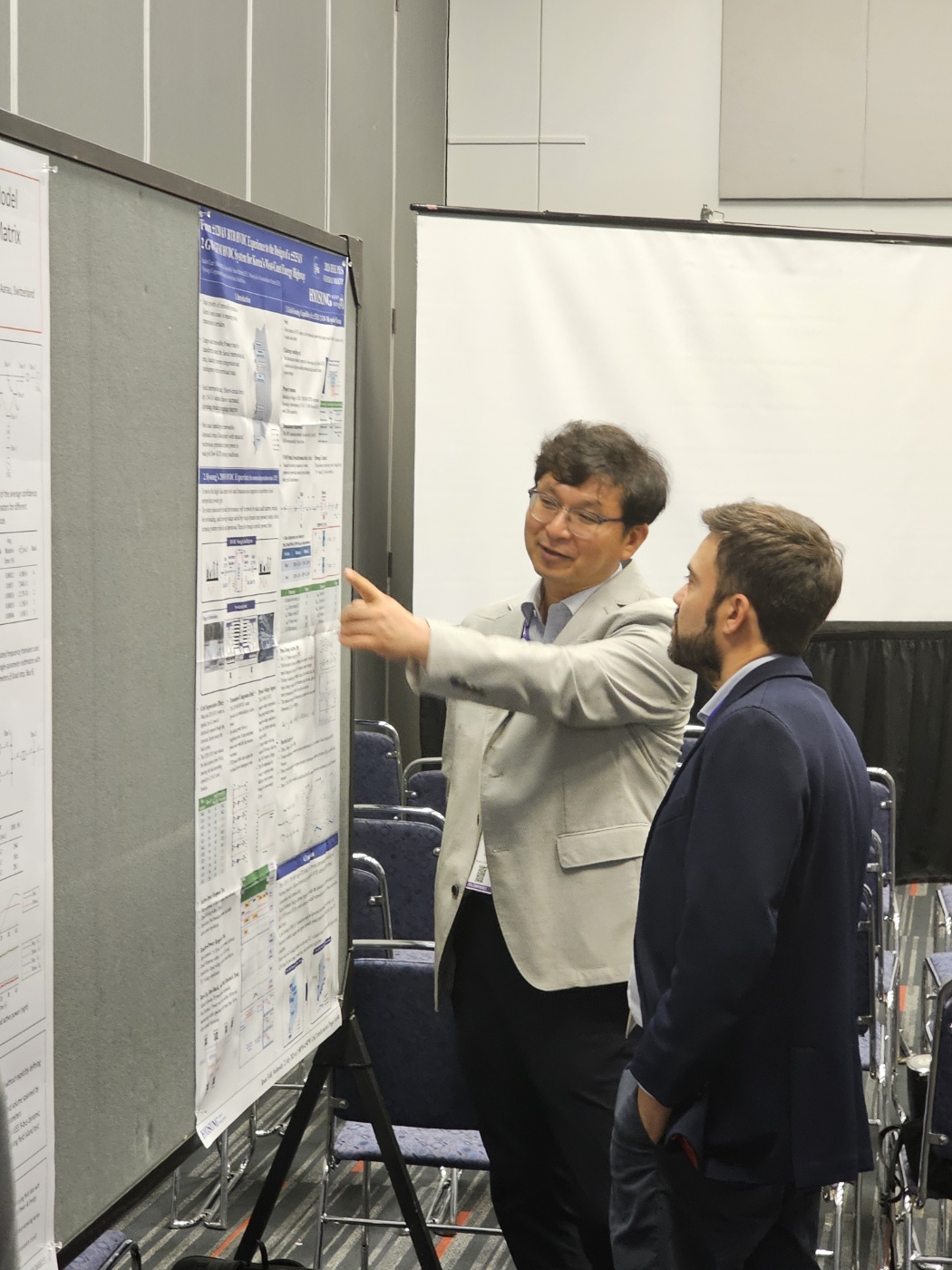
Researchers participated in PESGM 2026 in Montreal, Canada, where they shared their research achievements in large-scale GFM-HVDC system design, MTDC control, converter-driven oscillation analysis, and power-electronics-based grid stabilization with the international research community.
Researchers participated in PESGM 2026 in Montreal, Canada, where they shared their research achievements in large-scale GFM-HVDC system design, MTDC control, converter-driven oscillation analysis, and power-electronics-based grid stabilization with the international research community.
What happened
Junchul Lee presented a poster titled “From ±120 kV BTB HVDC Experience to the Design of a ±525 kV 2 GW GFM HVDC System for Korea’s West-Coast Energy Highway.” Based on the design and commissioning experience gained from Korea’s first ±120 kV, 200 MW Yangju BTB MMC-HVDC system, the study proposed design strategies and grid-stabilization technologies for a ±525 kV, 2 GW bipolar GFM-HVDC system intended for the West Coast Energy Highway.
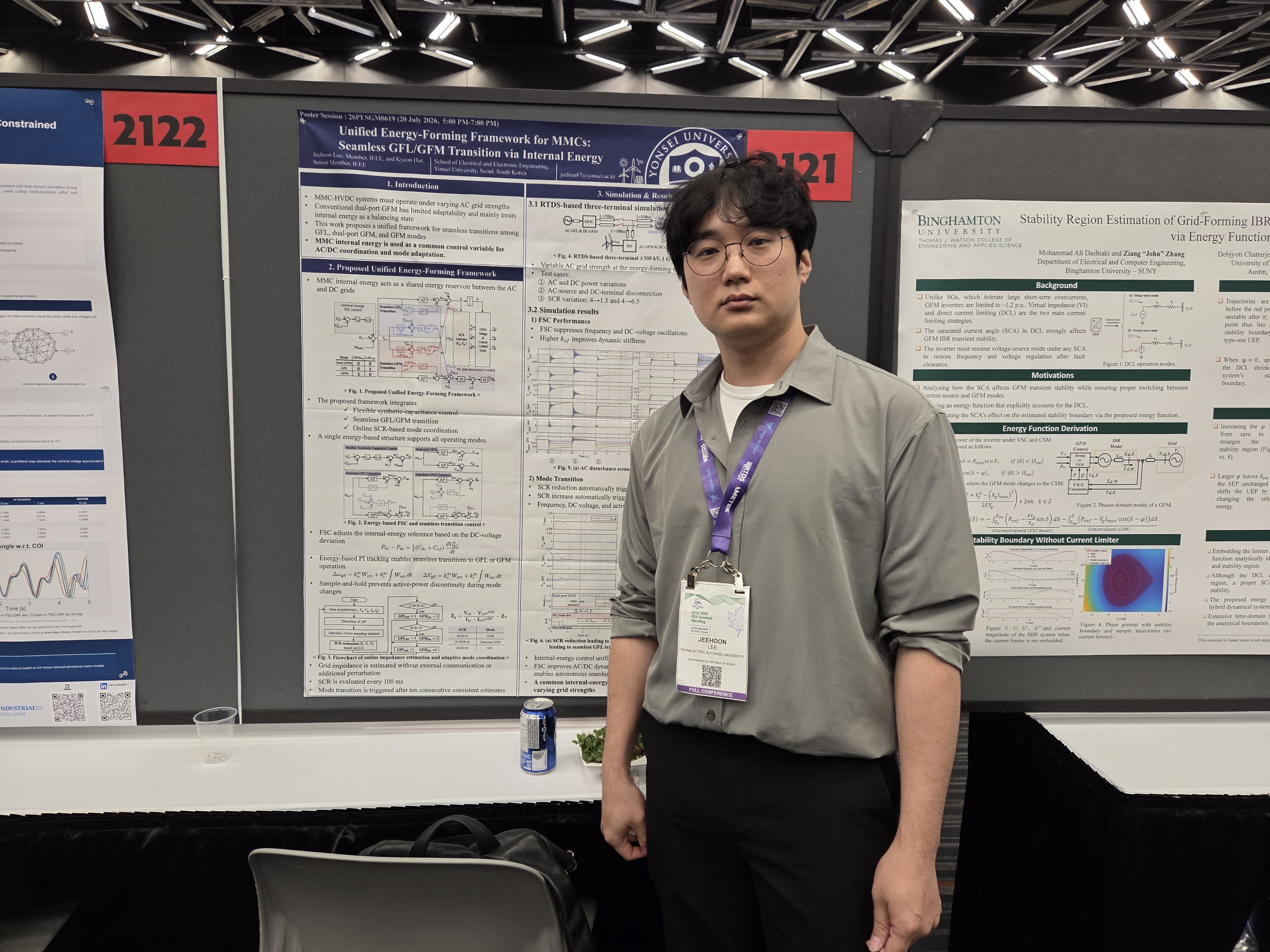
Jeehoon Lee presented a poster titled “Unified Energy-Forming Framework for MMCs: Seamless GFL/GFM Transition via Internal Energy.” The study proposed a unified control framework that uses the internal energy of an MMC as a common control variable between the AC and DC grids, enabling automatic transitions among GFL, dual-port GFM, and GFM operating modes in response to changes in grid strength. RTDS-based simulations of a three-terminal MTDC system demonstrated that frequency, DC voltage, and active power remained continuous during mode transitions.
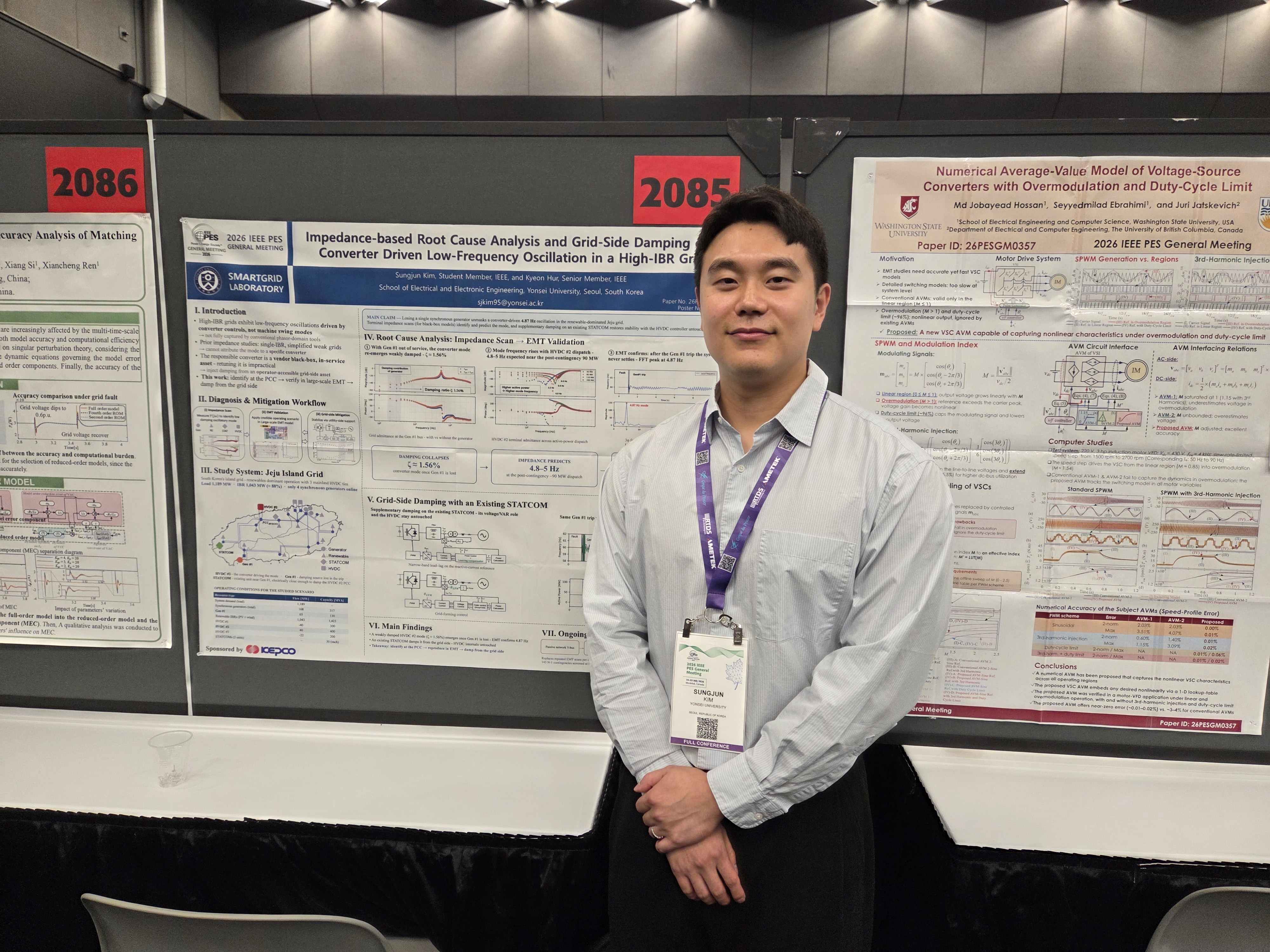
Sungjun Kim presented a poster titled “Impedance-based Root Cause Analysis and Grid-Side Damping of a Converter Driven Low-Frequency Oscillation in a High-IBR Grid.” The study used impedance analysis to identify the cause of a converter-driven low-frequency oscillation that emerged following the loss of a synchronous generator in the renewable-dominated Jeju power system. EMT simulations demonstrated that supplementary damping control implemented through an existing STATCOM could suppress the oscillation without modifying the HVDC controller.
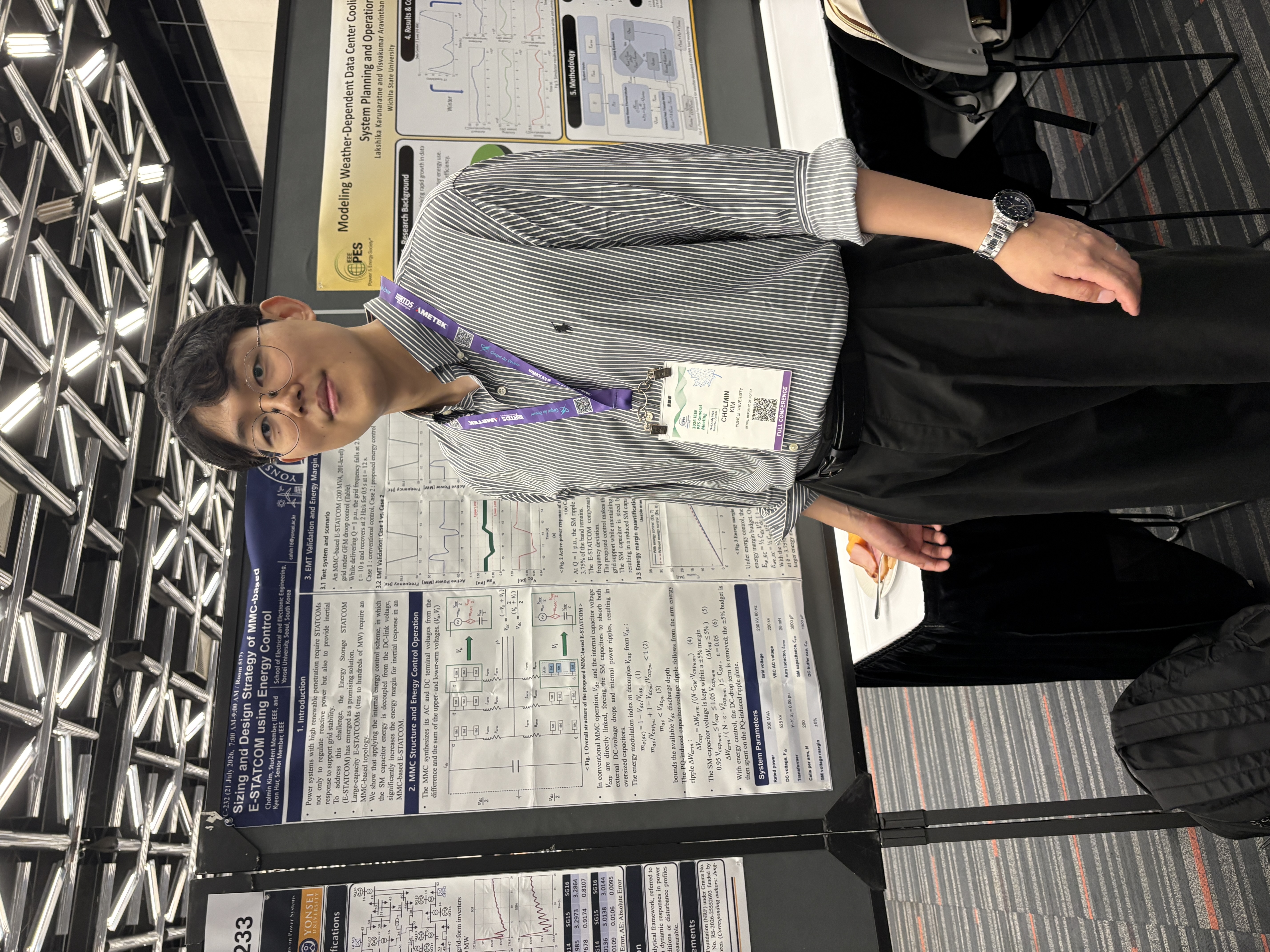
Cholmin Kim presented a poster titled “Sizing and Design Strategy of MMC-based E-STATCOM Using Energy Control.” The study proposed a design approach that applies internal energy control to an MMC-based E-STATCOM, decoupling submodule capacitor energy from the DC-link voltage. This approach increases the energy margin available for inertial response to grid-frequency variations while reducing the required submodule capacitance. EMT simulations also demonstrated that the E-STATCOM could provide active-power-based inertial response within the allowable voltage range while simultaneously supplying reactive power.
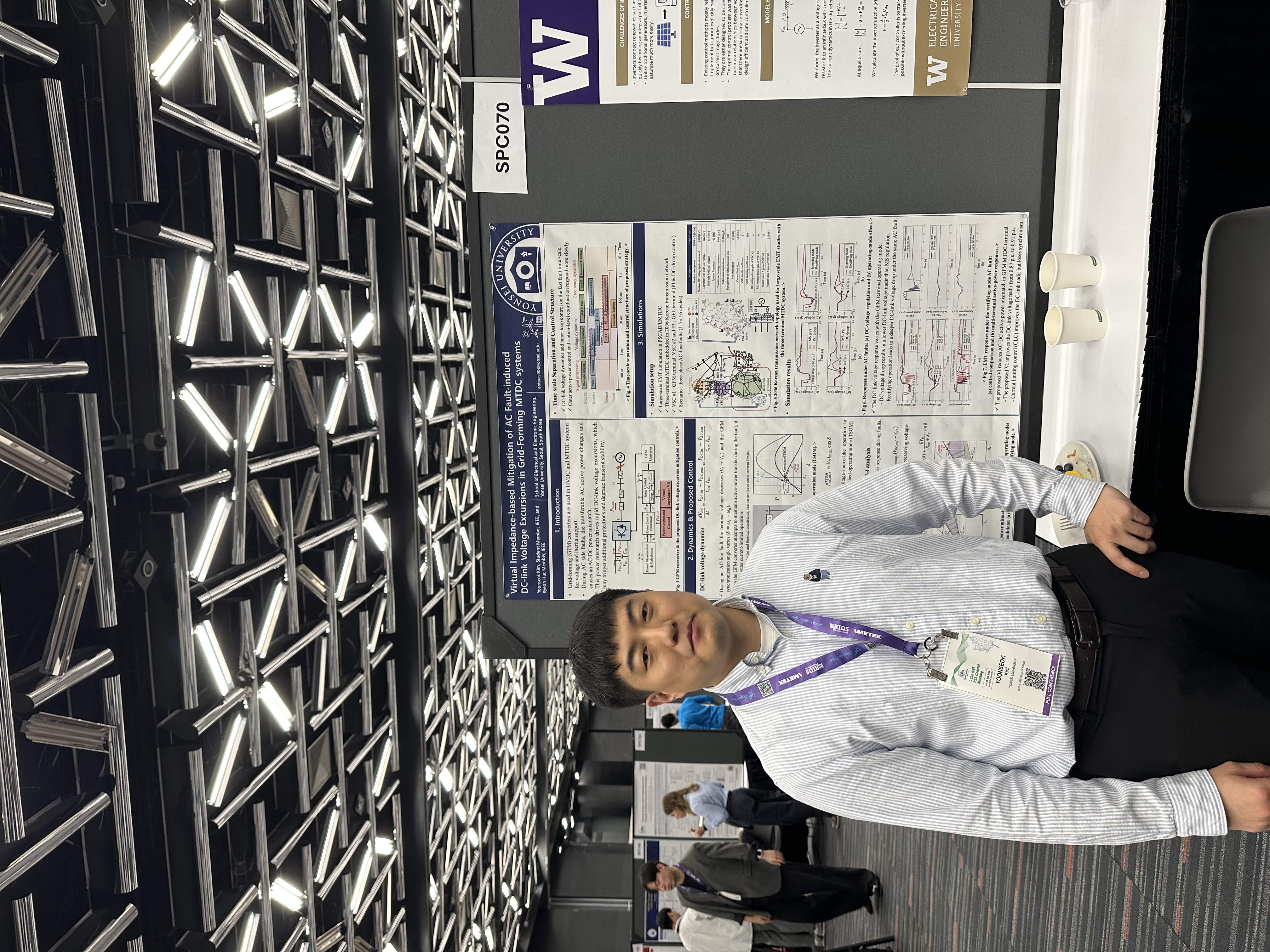
Yoonseok Kim presented a poster titled “Virtual Impedance-based Mitigation of AC Fault-induced DC-link Voltage Excursions in Grid-Forming MTDC Systems.” The study proposed a virtual-impedance control method to mitigate AC-DC power imbalances and DC-link voltage excursions caused by AC-side faults in GFM-MTDC systems. Large-scale EMT simulations of a three-terminal MTDC system embedded in Korea’s planned 2036 transmission network confirmed that the proposed control effectively mitigated DC-link voltage drops while preserving the converter’s voltage-source characteristics and synchronizing stability.
Photo record
More from the activity