

Publication of the PESGM 2026 Special Report
The C2 GRID HUB Research Center published an independently developed special report titled Changes in the Power Grid Observed at PES GM 2026, analyzing the event’s major technical themes and on-site discussions. The report examines how large-scale data centers and power-electronics-based facilities are reshaping power systems and summarizes the latest developments spanning grid-support technologies using GFM converters, E-STATCOMs, and HVDC systems; PMU-, AI-, and wide-area-EMT-based analysis; and power-system protection and restoration.
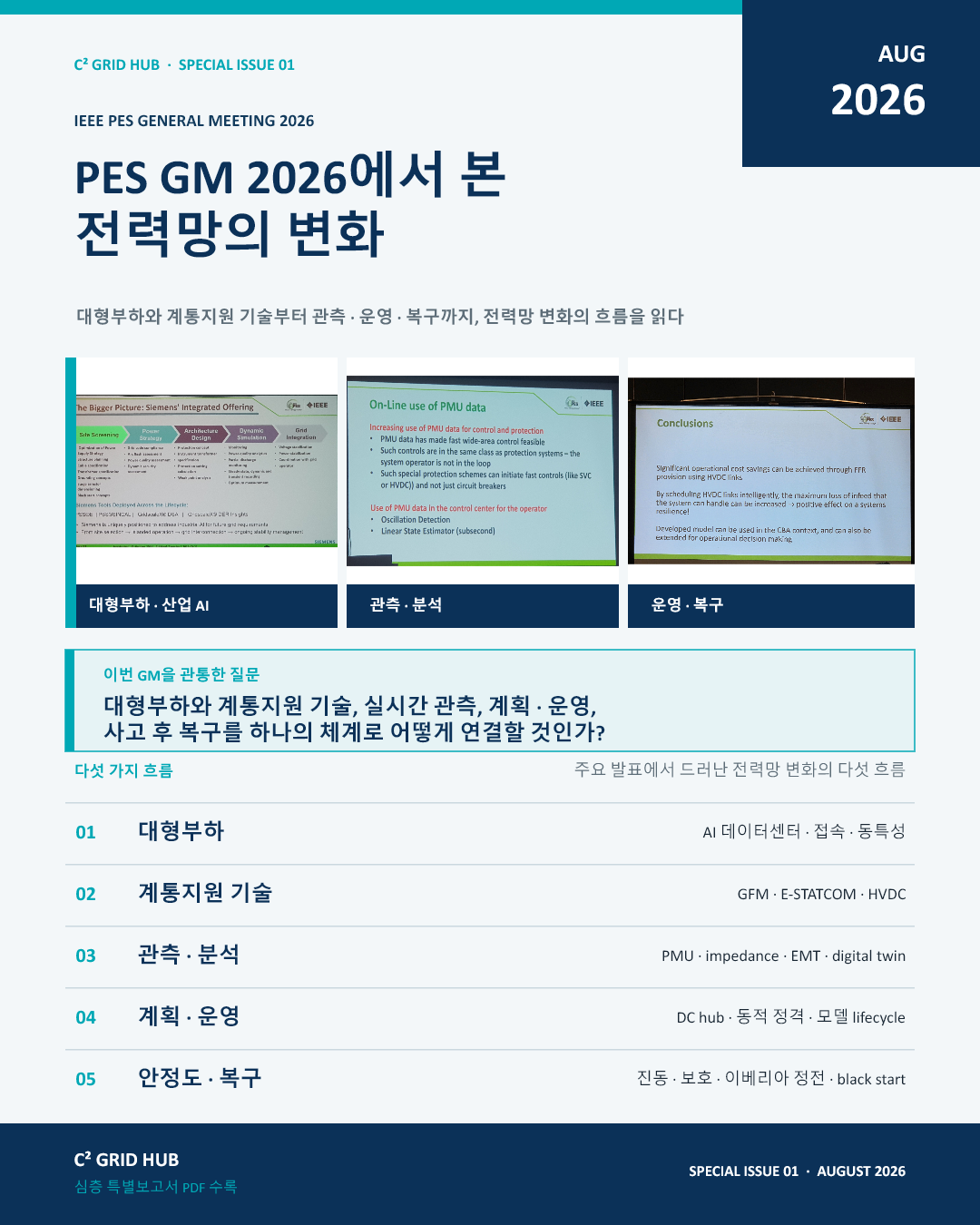
The C2 GRID HUB Research Center published an independently developed special report titled Changes in the Power Grid Observed at PES GM 2026, analyzing the event’s major technical themes and on-site discussions. The report examines how large-scale data centers and power-electronics-based facilities are reshaping power systems and summarizes the latest developments spanning grid-support technologies using GFM converters, E-STATCOMs, and HVDC systems; PMU-, AI-, and wide-area-EMT-based analysis; and power-system protection and restoration.
What happened
The C2 GRID HUB Research Center published a special report titled Changes in the Power Grid Observed at PES GM 2026, based on an analysis of the event’s public technical programs, official tutorials, presentation materials, and records from on-site sessions. The report organizes the major discussions into key themes, including large electronic loads and data centers; weak grids, grid-forming technologies, and system strength; oscillations, subsynchronous oscillations, and impedance analysis; PMUs, AI, wide-area EMT simulation, and model lifecycle management; and HVDC systems, protection, blackouts, and grid resilience.
The report finds that the expansion of AI data centers and inverter-based resources is increasingly blurring the boundaries among generation, load, and control. It emphasizes that power-system planning and operation must consider not only interconnection capacity but also load ramp rates, protection settings, ride-through behavior, reconnection procedures, and control modes. It also recommends evaluating GFM converters, E-STATCOMs, and HVDC systems based on their grid-support functions, locations, response durations, current limits, and testing conditions rather than solely on equipment type or rated capacity. In particular, the report presents a step-by-step C2 GRID HUB validation platform that connects field and PMU data alignment, risk screening, model-fidelity allocation, RMS, impedance, and EMT analyses, HIL and field replay, and operational decision-making. To further develop this platform, the report identifies priority research areas, including the establishment of a dynamic benchmark for data centers, chirp-based impedance scanning and the quantification of GFM support requirements, and the evaluation of speed–accuracy trade-offs in accelerated PSCAD-based EMT simulations. It also proposes a corresponding 90-day implementation plan.
Attached report
Detailed PDF
PESGM2026_C2GRID_특별보고서.pdf
Open PDF ↗