Sharing Key Research Achievements in HVDC and Power Cable Technologies
The Converter and Cable research teams of C2-GRID presented their key research achievements in the design and stability of GFM-HVDC and MTDC systems, large-scale EMT modeling, cable diagnostics, and power transmission capacity enhancement. Prior to the presentations, Sunghan Kim demonstrated the MMC HVDC Design Tool developed in-house by the research team, highlighting the potential for practical application of its research outcomes.
The Converter and Cable research teams of C2-GRID presented their key research achievements in the design and stability of GFM-HVDC and MTDC systems, large-scale EMT modeling, cable diagnostics, and power transmission capacity enhancement. Prior to the presentations, Sunghan Kim demonstrated the MMC HVDC Design Tool developed in-house by the research team, highlighting the potential for practical application of its research outcomes.
What happened
At the C2-GRID Industry Expert Workshop, the Converter and Cable research teams shared their key research achievements aimed at ensuring the stable design and operation of future HVDC systems and power cables. Prior to the presentations, Sunghan Kim demonstrated the MMC HVDC Design Tool, which was developed in-house based on the team’s MMC-HVDC design research, and introduced its key features and applications. The subsequent presentations covered the following research topics.
Converter Research Team
Sunghan Kim presented an analytical method for determining the stable operating region of MMC-HVDC systems under grid overvoltage conditions. The study quantified modulation limits according to AC grid voltage and reactive power operating conditions and proposed a framework for assessing high-voltage ride-through feasibility during the system design stage.
Seungyun Lee presented an integrated analytical approach for efficiently validating GFM-HVDC specifications and grid requirements. The proposed approach quantitatively assesses DC overvoltage and active-power responses before conducting repetitive EMT simulations under various disturbances, including grid faults and phase-angle jumps, thereby improving the efficiency of the specification validation process.
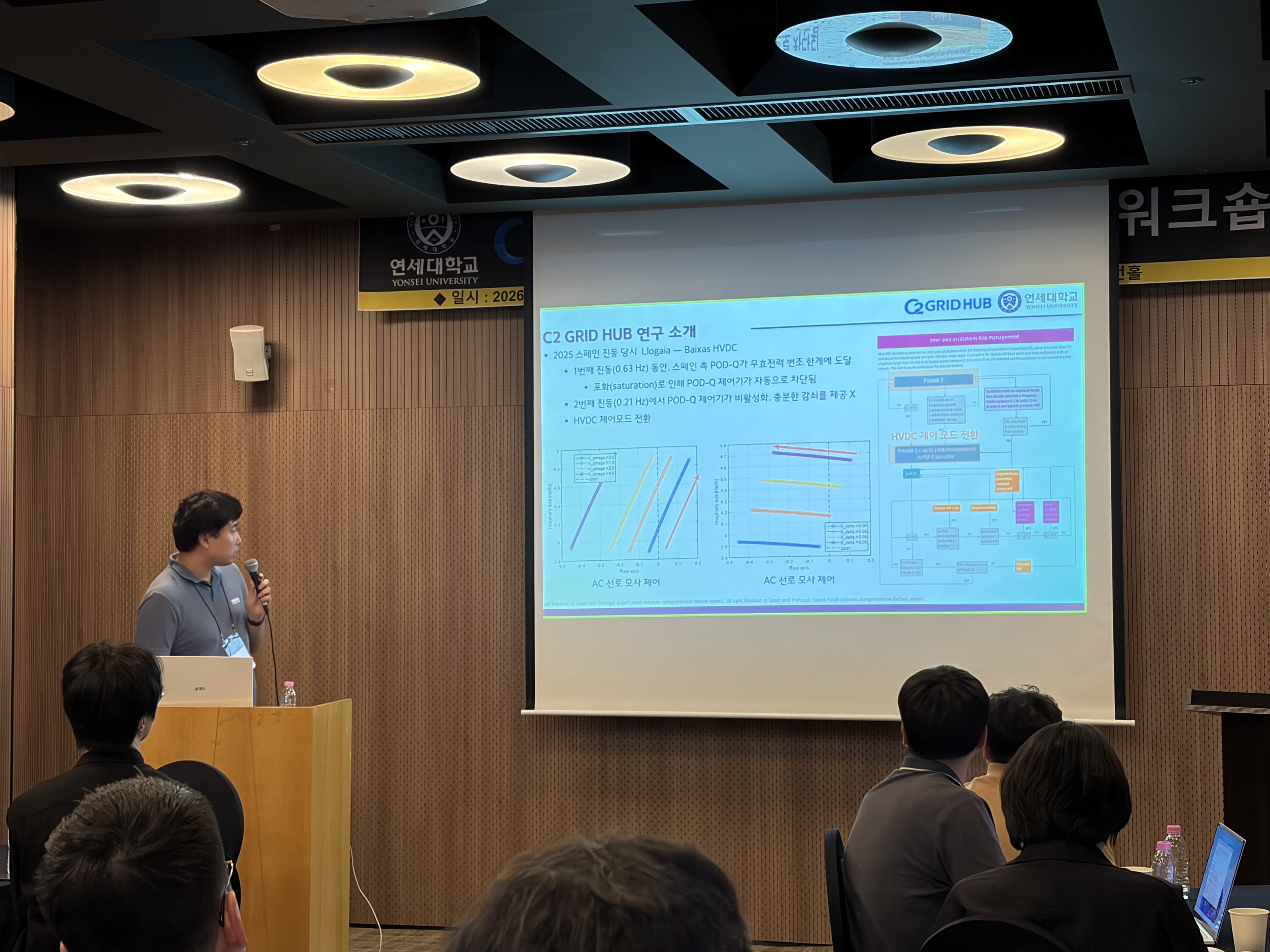
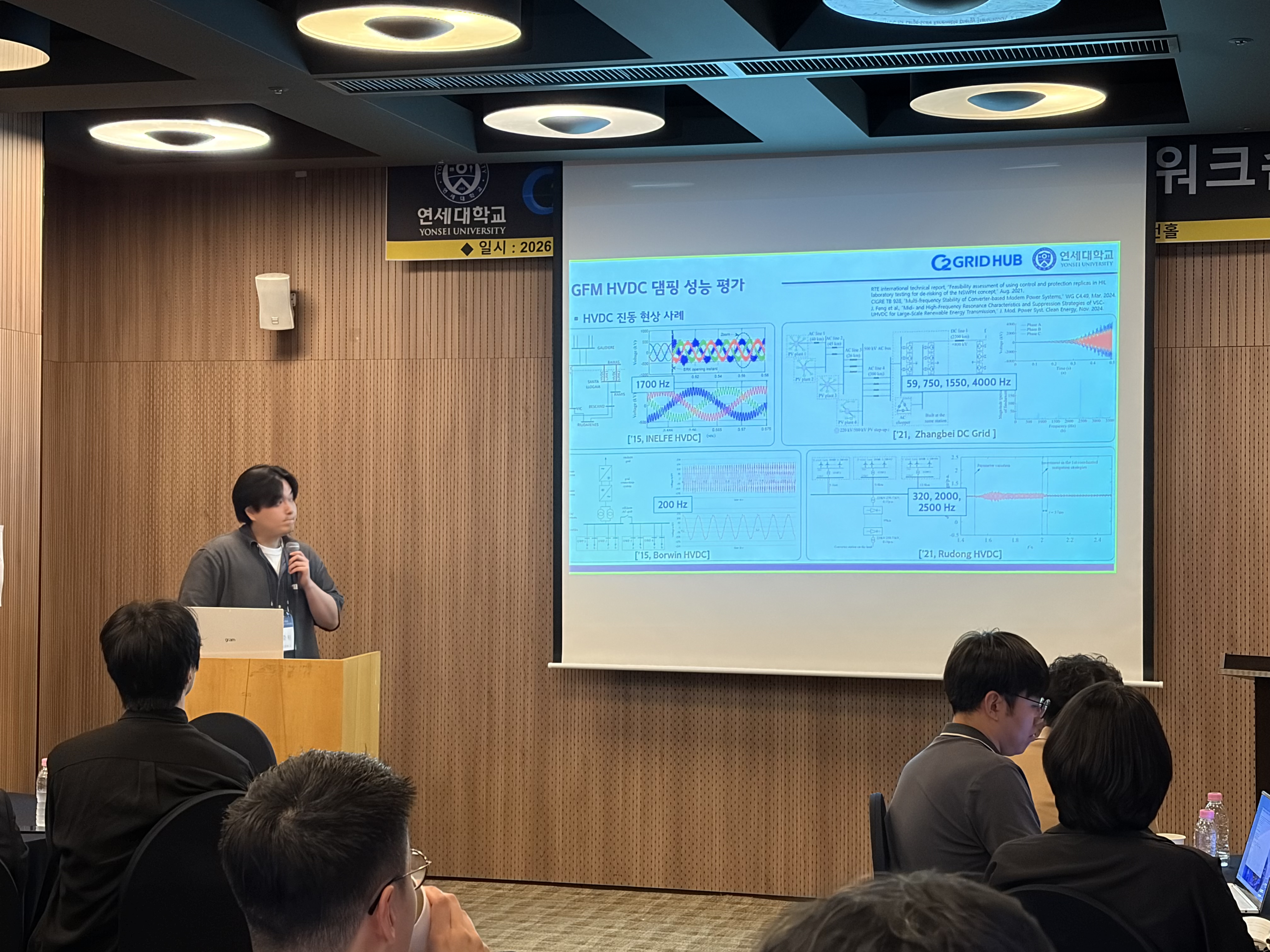
Jongwon Kang presented a method for evaluating the damping performance of GFM-HVDC converters. The presentation reviewed oscillation events observed in domestic and international HVDC systems and damping performance requirements proposed by overseas organizations. It also introduced a passivity-based validation method for assessing whether a converter contributes positively to power system stability.
Minsung Kim presented a control framework for enhancing stability and oscillation damping in HVDC- and MTDC-integrated power systems. The proposed framework coordinates measurement data and control inputs from multiple converters to mitigate inter-area oscillations and improve wide-area power system stability.
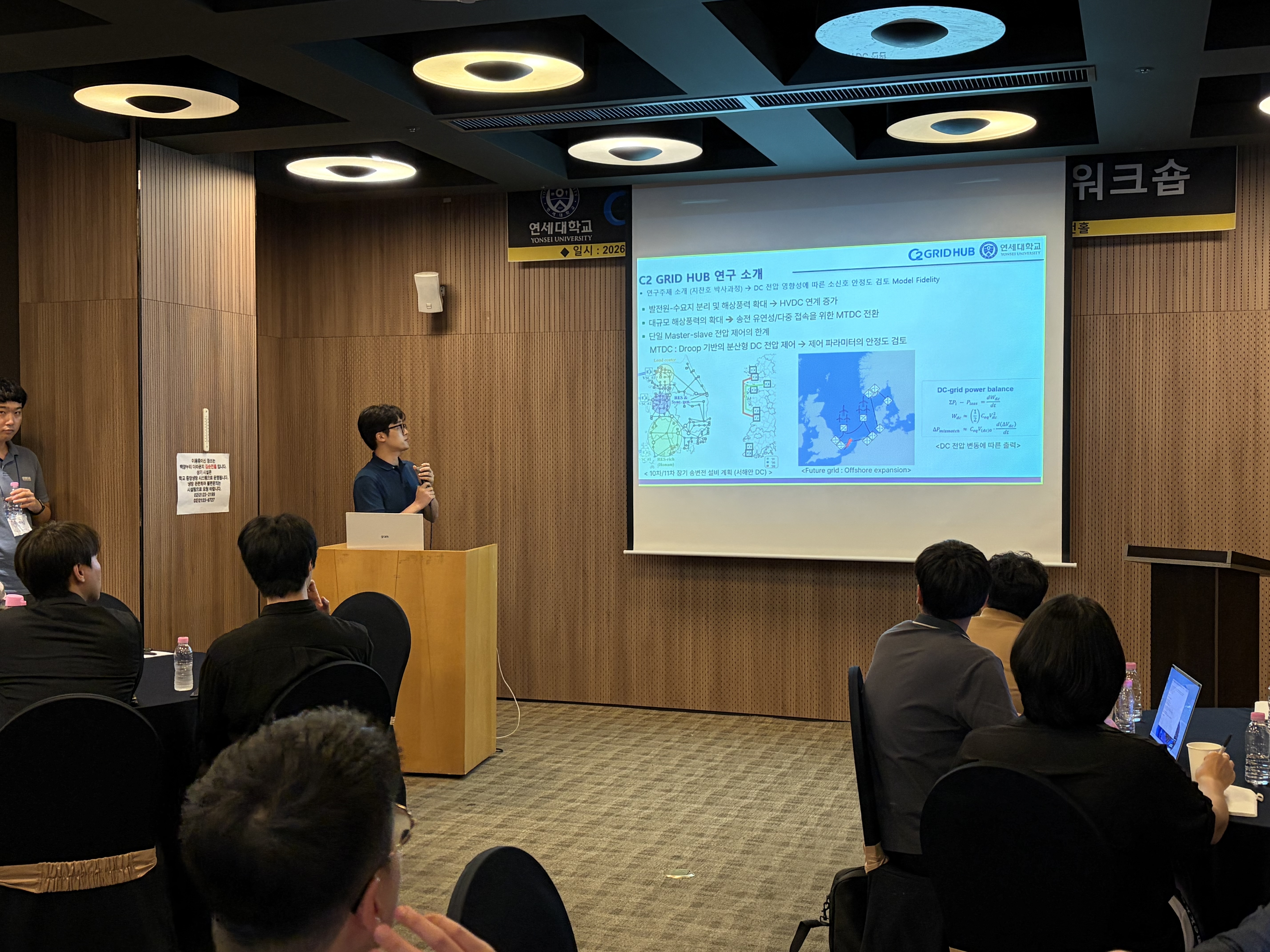
Chanho Ji presented research on the impact of MMC model fidelity on the small-signal stability assessment of MTDC systems. By comparing a detailed model incorporating MMC internal dynamics with a reduced-order model that neglects them, the study demonstrated the importance of selecting an appropriate level of model fidelity for the reliable assessment of DC-droop gains and system stability.
Cholmin Kim presented the development of a large-scale EMT model for the Honam-Jeju power system and its application to GFM-HVDC studies. The research used a nationwide EMT model to analyze oscillatory phenomena in HVDC-integrated power systems and assess the effectiveness of GFM control and DC-voltage excursion mitigation technologies.
Cable Research Team
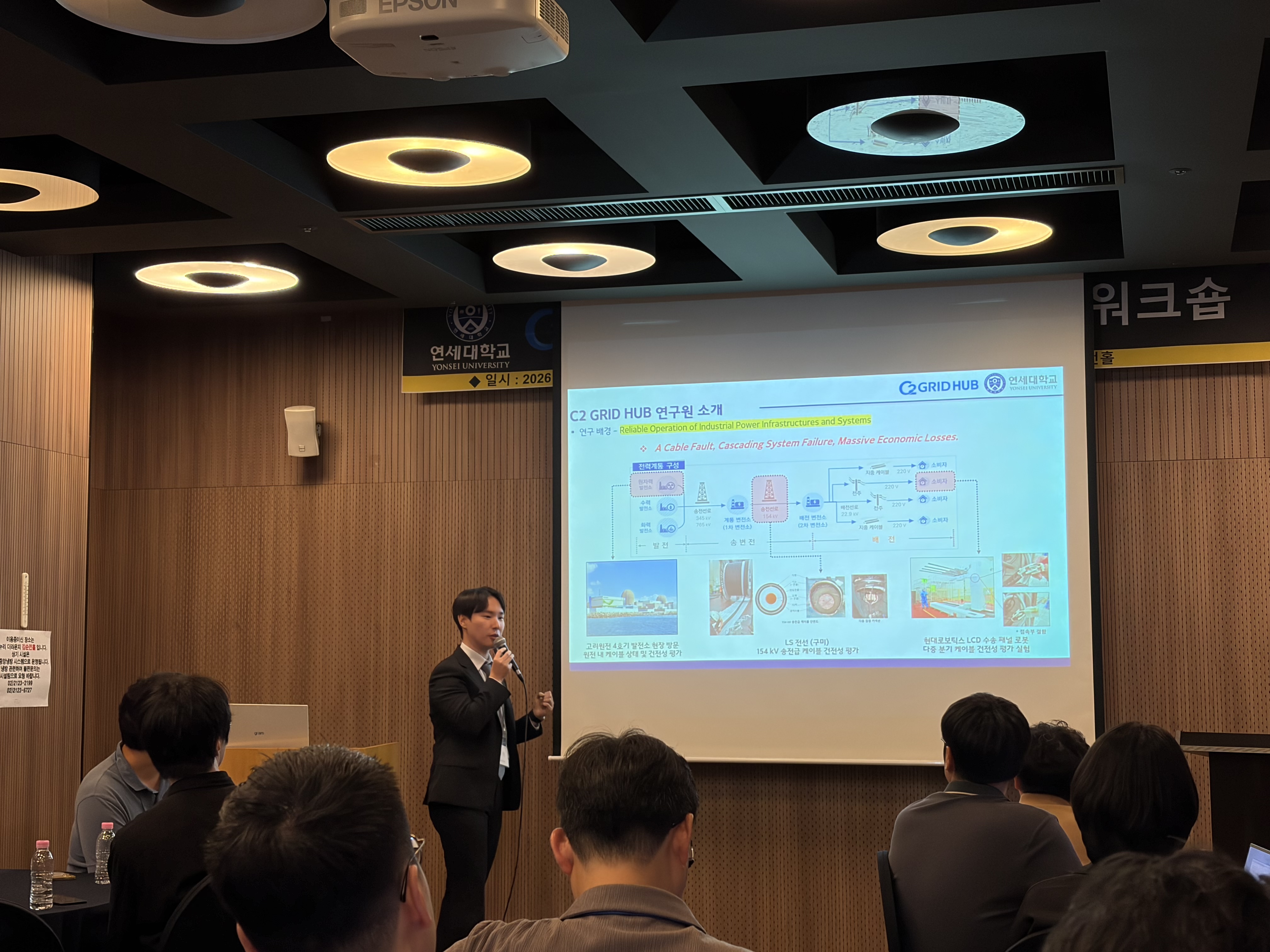
Professor Yongjune Shin introduced the Industrial Cable Research Team’s principal research areas and future directions, including diagnostic and condition-monitoring technologies for HVDC, nuclear power plant, superconducting, and industrial cable systems.
Hobin Lim presented research on industrial cable diagnostics using reflectometry and signal-processing techniques. The proposed technology applies low-voltage excitation signals to a cable and analyzes the reflected signals to infer hidden internal conditions, including faults and degradation. He also introduced applications of the technology to HVDC submarine cables, nuclear power plants, superconducting cables, robotics, and electric vehicle wiring systems.
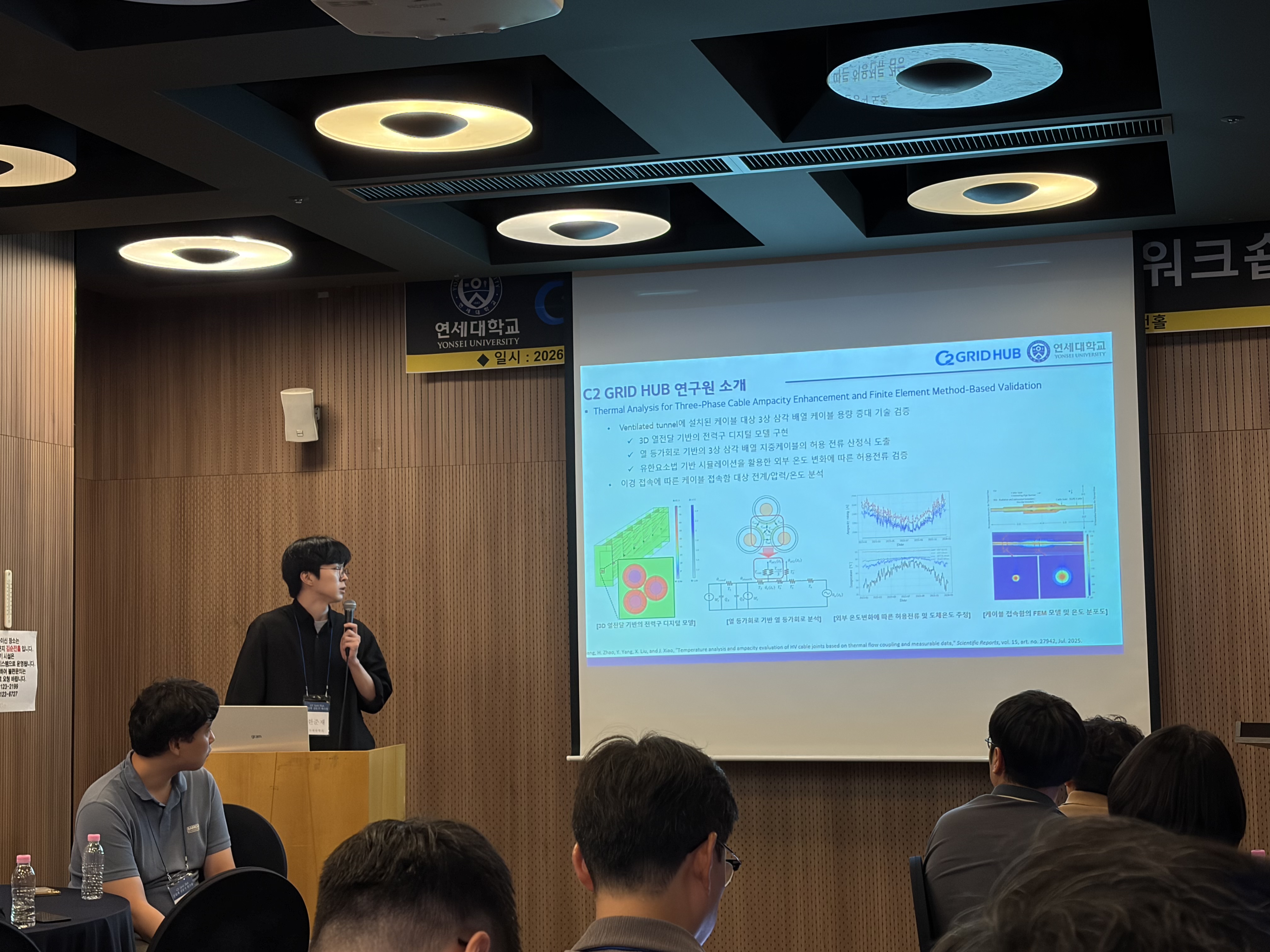
Jaeyong Ahn presented thermal analysis and finite-element-based validation research for enhancing the ampacity of three-phase power cables. The study developed a three-dimensional heat-transfer model and a thermal equivalent circuit for cables installed in ventilated tunnels and analyzed their ampacity and conductor temperatures under varying ambient conditions. It also examined the electric field, pressure, and temperature characteristics of cable joints connecting cables of different sizes.
Through these presentations, C2-GRID showcased the combined research capabilities of its Converter and Cable teams and shared an integrated research direction covering HVDC system design, control, and analysis, as well as power cable diagnostics and transmission capacity enhancement, with industry experts.
Photo record
More from the activity